Article
What an expired domain really costs
AUCTIONS & OWNERSHIP
Set your budget before your bid
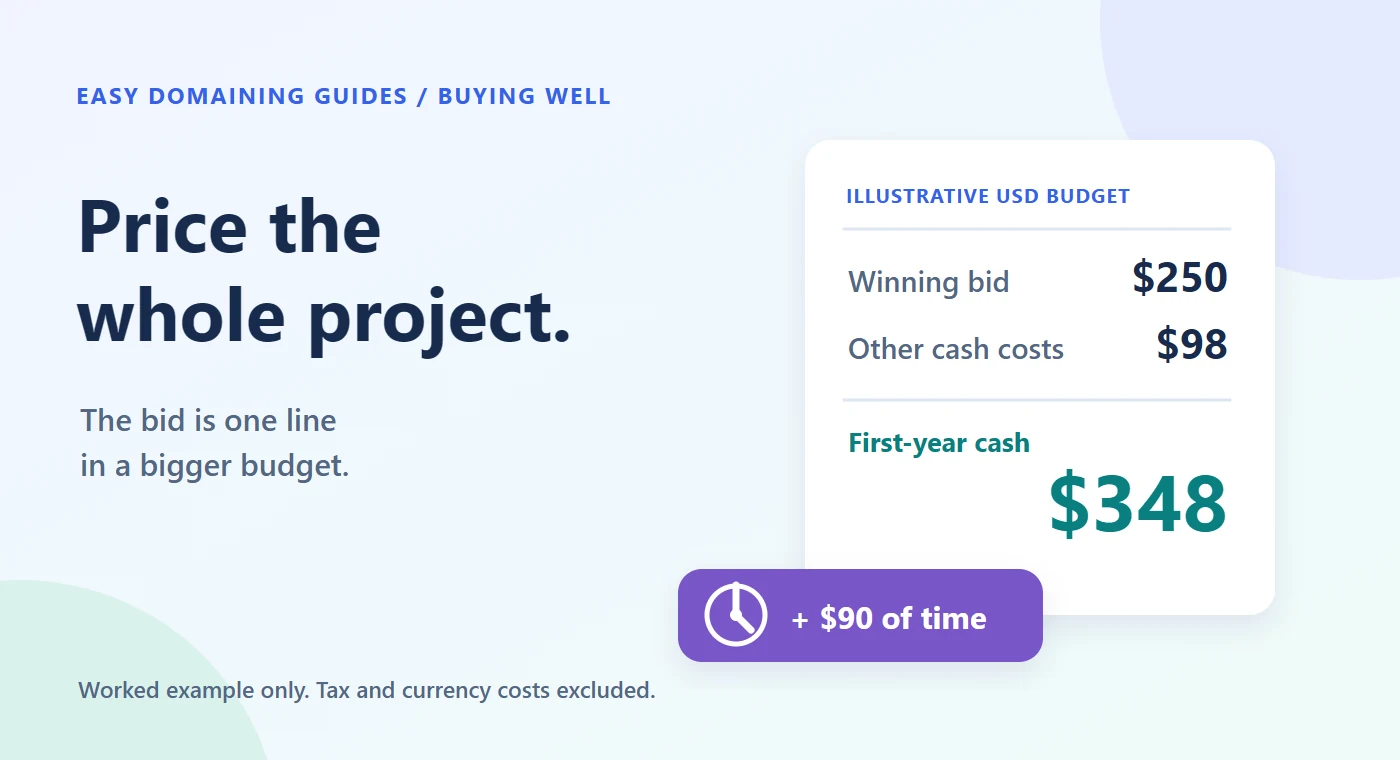
A $250 auction win can become a $348 first-year cash commitment before you write a single article. Add three hours of research and setup, valued at $30 an hour, and the same purchase represents $438 of money and time.
12 min read · Reviewed 28 September 2026
Those are illustrative figures, not a registrar quote. They show why a sensible bid starts with the project budget: the domain price is one line in it.
This guide separates the money needed to win a domain, the cost of keeping it, and the work needed to make it useful. You will finish with a three-year budget and a maximum bid you can calculate before an auction becomes exciting.
The short answer: budget for acquiring, holding and using the domain
Use three separate totals:
- Acquisition cash: winning bid or purchase price, compulsory buyer charges, and any registration or renewal required at delivery.
- Holding cash: later renewals, any transfer you choose, and recurring services you actually need.
- Project cost: acquisition and holding cash, plus research, content, technical work and your time.
Keep a contingency reserve alongside those totals. Money reserved for a possible problem is not money already spent.
The phrase “not already included” matters. A checkout may bundle registration with the acquisition. Adding another annual registration charge to your spreadsheet would overstate the cost. Conversely, assuming every displayed auction price includes renewal can understate it.
Start with the route you are buying through
“Expired domain” describes a history or lifecycle stage. It does not identify a single purchase process.
| Acquisition route | The starting price means | What to establish before committing |
|---|---|---|
| Available to register | The registrar’s registration offer | Registration term, renewal price and optional extras |
| Expired-domain auction | The current bid, or your eventual winning bid | Required renewal, buyer charges, payment deadline and delivery conditions |
| Closeout or fixed-price listing | The displayed acquisition price | Whether registration is included and when the next renewal is due |
| Backorder/drop catch | A request or starting acquisition amount | When payment becomes binding, what happens if the catch fails, and whether competing requests trigger an auction |
When building a shortlist in Easy Expired Domains, record the listing type and follow the provider link before assigning a budget. Comparing a hand-registration price with an auction’s current bid does not compare two final invoices.
What the major providers say about additional costs
These are examples of fee structures, not a cheapest-provider ranking. The exact domain, extension, account and listing can change what you pay.
GoDaddy: allow for renewal on top of a winning bid
GoDaddy’s auction agreement specifies the successful bid plus a domain renewal charge and an applicable ICANN fee. The renewal period runs from the end of the previous registration period, so do not assume you receive twelve full months starting on delivery day. Check the resulting expiration date. GoDaddy auction agreement
For budgeting, use winning bid + displayed renewal + applicable compulsory charges. A first-year promotional registration offer is not evidence of the renewal rate for your auction purchase. Save the domain-specific payment breakdown with your research.
Dynadot: distinguish the renewal charge from account funding
Dynadot describes the expired-auction total as the winning bid plus renewal. Its help page also requires US$5 of account spending to participate; a US$5 prepayment can be used towards a purchase. For bids of US$2,000 or more, it specifies a 10% deposit, held until you are outbid or the order is paid. Non-payment after winning can forfeit that deposit. Dynadot expired-auction rules
A deposit or usable account credit affects the cash you must have available. It is not automatically an additional expense on top of the invoice. Track cash committed separately from fees consumed.
Namecheap: the subscription is a fee; the account balance is funding
Namecheap’s bidding guide lists a US$5 annual auction subscription and a US$100 account-balance minimum during onboarding. The subscription renews automatically and is non-refundable. Its exported auction data includes a renewal-price field, which is useful when comparing candidates. Namecheap auction bidding guide
Allocate the subscription across your buying activity, then inspect the individual listing’s renewal and checkout terms. Do not add the entire US$100 account top-up as an expense and then count the purchases paid from that same balance again.
Backorders: a low starting amount is not a price ceiling
Dynadot states that placing a backorder request is free and payment depends on a successful catch. Multiple requests can lead to a public backorder auction. That is a specific provider’s model; other services may have different credit, deposit or cancellation rules. Dynadot backorders
Before using several services, write down each one’s payment trigger and whether its quoted acquisition amount includes registration. Budget for a possible auction, not just the opening amount. A failed request can still consume your research time even when no acquisition fee is payable.
Build the renewal calendar before the bidding calendar
The renewal amount belongs next to the bid limit, not in a note you read a year later.
For each candidate, record:
- The registrar that will hold the domain after delivery.
- The expiration date you expect to receive, and any transfer or auction lock.
- The ordinary renewal price, billing currency and minimum renewal term.
- Whether the name has a registry-premium renewal price.
- The date you will decide to keep, develop, sell or drop it.
“Premium” is particularly easy to misread. A high resale price set by an existing owner and a registry-premium registration are different things. Namecheap explains that registry premiums can also carry special renewal and transfer pricing. A low auction bid does not answer that question. Namecheap’s premium-domain explanation
Use the actual term rather than forcing every extension into a one-year model. For example, Namecheap currently states that .ai cannot be renewed for just one year. Namecheap renewal guidance
Count research across the domains you reject, too
A purchase can look artificially cheap when it inherits none of the cost of finding it.
Suppose you spend an illustrative $100 in a month on subscriptions and data, review 50 names, and buy five. Allocating that month’s research spend equally gives $20 per acquisition, not $2. You can allocate differently, but use a method that accounts for rejected candidates and does not hide unused subscriptions.
Domain Hunter Gatherer can support discovery and shortlisting; DomDetailer supplies domain metrics through its tools and API. If those are part of your workflow, use the price you actually pay, relevant credit usage and any included allowances. A bundled feature should not be counted as another separate subscription.
Record your time separately. An hour reviewing backlinks and archived pages still has a cost when nobody sends you an invoice. This is especially important when comparing a researched $100 purchase with an apparently effortless $20 registration.
For the checks worth doing, use our companion guide, Checks that catch problems high domain scores miss.
A worked first-year and three-year budget
Here is a fictional small content project. It assumes a $250 winning bid, a separate $18 registration/renewal charge covering the first budget year, $20 of allocated research subscriptions, and $60 a year of hosting. Research and setup take three hours valued at $30 an hour.
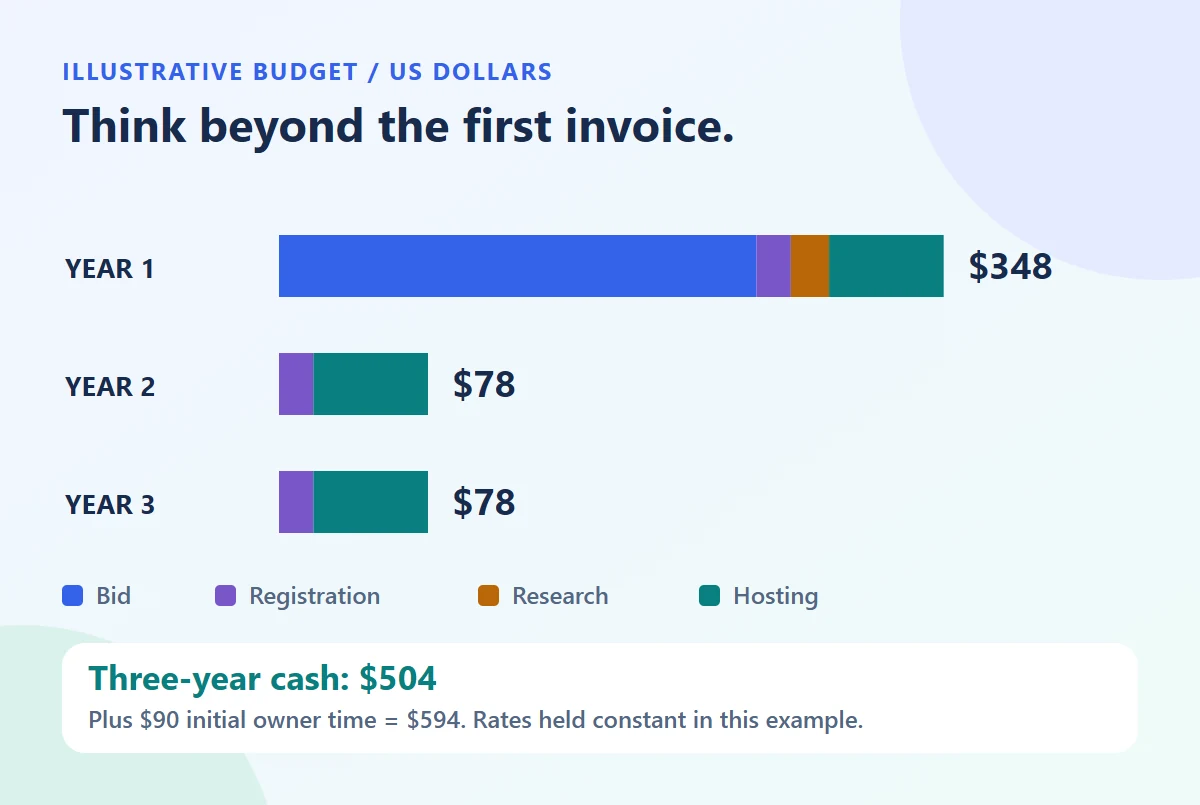
The example assumes the registration coverage is confirmed, renewal and hosting rates remain unchanged, no transfer is made, and no extra content, contractors or maintenance are purchased. It excludes tax, exchange-rate costs and any income. These are deliberately visible assumptions, not an estimate of a typical site’s costs.
| Budget item | First year | Second year | Third year |
|---|---|---|---|
| Winning bid | $250 | $0 | $0 |
| Required registration/renewal | $18 | $18 | $18 |
| Allocated research subscriptions/data | $20 | $0 | $0 |
| Hosting for the planned project | $60 | $60 | $60 |
| Cash subtotal | $348 | $78 | $78 |
| Owner research/setup time | $90 | $0 | $0 |
| Cash plus valued time | $438 | $78 | $78 |
Three-year cash is $504: $348 + $78 + $78. Including the initial time allowance gives $594. A separate $50 contingency brings the first-year planning envelope to $488, but remains unspent unless needed.
Your project may need no hosting while you hold the domain. Or it may need a substantial editorial and development budget. Change the services and labour rows to match the intended use; do not treat the example’s $0 future labour as a promise that a live site maintains itself.
Download the worked budget as a CSV. It includes quantities, rates and separate cash and time rows so you can replace the assumptions in a spreadsheet.
Work backwards to your maximum bid
Choose the total you are comfortable committing before choosing the bid.
Using the same project assumptions, suppose your first-year ceiling is $500 including valued time and a $50 reserve. The non-bid costs are $188: $18 registration + $20 research allocation + $60 hosting + $90 time.
If the next permitted auction increment is above $262, this budget says stop. A proxy-bid box asks for your maximum bid, not your maximum all-in project spend.
Where a provider applies a buyer surcharge calculated as a percentage of the bid, include that in the calculation. With a purely hypothetical 10% surcharge and the same other assumptions, the bid limit becomes ($500 − $188 − $50) ÷ 1.10 = $238.18. This illustrates the formula; it does not assert that any provider above charges 10%.
Recalculate using the actual taxable amounts, minimum fees and permitted increments at checkout. A reserve protects against uncertainty; it does not make an unaffordable domain affordable.
Transfers and redemption: two different budget problems
Moving to another registrar
For transfers covered by ICANN’s Transfer Policy, a completed holder-authorized registrar transfer adds one year, subject to a maximum ten-year unexpired term. Transfer restrictions can apply after registration, a previous registrar transfer or certain registrant changes. Country-code extensions have their own rules. ICANN Transfer Policy
Count the transfer payment, then map the registration period it buys. Do not also budget an ordinary renewal for the same coverage. There are exceptions: Namecheap warns that an expired domain renewed at its previous registrar and transferred during the relevant 45-day window may not gain the additional year. Confirm the resulting expiration date with the registrars before relying on a saving. Namecheap’s transfer-year guidance
Recovering your own expired registration
Redemption is a recovery process for the existing registrant. It is not a routine fee every auction buyer pays. ICANN explains that registrars must disclose renewal and redemption/restore fees, and that recovering a deleted registration during the applicable redemption period can incur a fee. ICANN’s expiration and recovery guidance
As a concrete example checked on 28 September 2026, Namecheap displays US$88.48 for .com redemption, calculated as redemption plus renewal. Its page notes an applicable US$0.20 ICANN charge and that premium prices may differ; confirm the final amount with support. Do not add an ordinary renewal again to a redemption total that already includes it. Namecheap redemption pricing
For names you keep, set reminders ahead of the registrar’s renewal deadline, check payment details and verify that renewal succeeded. Avoiding a preventable recovery bill is simpler than optimising one.
Restoring a website is a separate purchase decision
A domain budget does not automatically buy a functioning business, editable website, content licence or customer database.
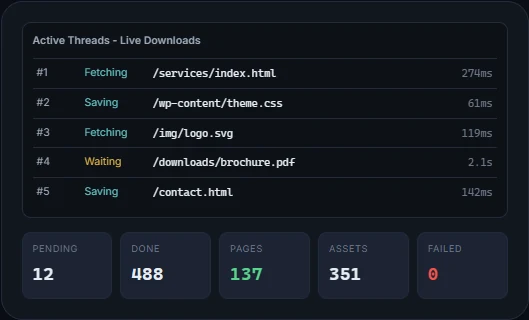

If you have permission to reuse archived material, DomRecovery can recover captured pages and assets into a local copy for review. Its product guidance distinguishes those files from databases, login areas and functioning server-side features, and says archive availability does not grant publishing rights.
Budget for reviewing the recovered files, replacing missing assets, updating content, rebuilding forms and removing anything you should not publish. When permission is absent or the old site is unsuitable, price an original build instead. Recovery software can reduce repetitive work; it cannot decide whether the result meets your project’s needs.
Five questions before placing the bid
The useful number is the cost of owning a domain you can actually use. A disciplined budget makes that number visible while you still have the option to walk away.
Frequently asked questions
Does a winning auction bid include renewal?
Sometimes it is separate. GoDaddy and Dynadot explicitly describe renewal charges on top of successful expired-auction bids. Check the particular listing and checkout rather than assuming one rule covers every marketplace or sale type.
Do I pay a redemption fee when buying someone else’s expired domain?
Not as a universal acquisition charge. Redemption concerns recovery of an existing registration. Your auction invoice has its own acquisition and registration charges; use that breakdown rather than adding an assumed redemption fee.
Is a backorder guaranteed to secure the domain at the advertised amount?
No. A service may fail to catch it, and a successful catch with competing requests may proceed to auction. Check that provider’s payment and competition rules before requesting it.
Should I include my own time in the budget?
Yes, in a separate column. It will not change the registrar’s invoice, but it helps you compare opportunities honestly and decide how much research is proportionate.
Can I budget on the assumption that the domain will resell?
Build a holding budget you can cover without a sale. You can model possible resale proceeds separately, including selling costs, but an asking price or automated appraisal is not cash available for your next renewal.
Prepared for publication: 28 September 2026. Recheck provider charges and terms before bidding; this guide’s formulas are intended to remain useful when individual prices change.
Continue your research
DOMAIN DUE DILIGENCE
Checks that catch problems high domain scores miss
A practical expired-domain due diligence checklist: inspect history, surviving links, traffic assumptions, rights and costs before a high score turns into an expensive mistake.
Read the guideTRAFFIC & RESEARCH
What happens to traffic estimates 30 and 90 days after expiry?
Learn what can change after expiry, why estimated traffic differs from visits, and how to compare a domain at baseline, day 30 and day 90 without misleading yourself.
Read the guide